
See how our services
make an impact.
Redefining Value: Insights and Leadership Lessons from Gartner IT Symposium
The reality check of AI and technical trends seen at the 2025 Gartner IT Symposium.
When Tonic attended the Gartner IT Symposium last month, we knew AI would dominate the conversation. The conference brought together thousands of technology leaders, all grappling with the same questions: How do we harness this moment? And more importantly, what comes next? The energy was palpable, and the acronym was in fact everywhere. Headlines about AI's potential to remake industries, accelerate discovery, and redefine productivity weren't just buzzwords in presentations, they were the foundation of every keynote, breakout session, and hallway conversation.
What struck us the most as we moved through the symposium is that the most profound shifts aren't about the technology itself. They're about the surprising, sometimes counter-intuitive ways AI is reshaping our work, our businesses, and our very definition of value. The real revolution is happening at the human level, creating unprecedented opportunities that go far beyond the code. Below we explore the insights gathered from CIOs, analysts, and innovators as we navigate the emerging transformation that every leader should not only acknowledge, but embrace.
AI Isn't Just Changing Jobs, It's Democratizing Expertise
Rather than simply replacing human workers, AI is creating an exciting opportunity to reimagine career development. We're experiencing two complementary phenomena: "Experience Compression" and "Experience Acceleration" that are transforming how we build and share knowledge.
Experience Compression is the remarkable ability of AI to enable early-career workers to perform at surprisingly high levels on complex tasks. Generative AI serves as an always-available mentor, compressing years of accumulated knowledge into an immediate on-demand resource and helping people contribute meaningfully from day one.
At the same time, expert workers are discovering Experience Acceleration, using AI to amplify their capabilities and focus on higher-level strategic thinking, innovation, and mentorship. This creates space for reimagining how we develop talent, moving beyond rote task completion and towards critical thinking, creativity, and uniquely human skills.
The opportunity is transformative as we can redesign the career ladder for the AI age. By thoughtfully integrating AI into learning and development, we can create new pathways where junior workers learn to work with AI while developing deep expertise, critical judgment, and creative problem-solving. This isn't a crisis, it's an invitation to build a more effective and inclusive talent development system.
Your Next Customer Might Not Be Human, and That's Exciting
For years, business strategy has evolved from physical to digital. The next great leap is into an era of "Autonomous Business," and its most promising feature is the rise of the "Machine Customer." As a core pillar of this transformation, alongside autonomous operations, auto-adapting products, and an augmented workforce, this represents an extraordinary new frontier where AI agents can transact on behalf of individuals and organizations.
These sophisticated autonomous economic agents will be capable of observing, negotiating, buying, and selling, creating unprecedented efficiency and scale. This shift is already energizing the world's largest companies.
What makes this agentic future so compelling for Amazon, is that these agents are going to change the scope and speed at which we can innovate for customers.
Andy Jassy, CEO, Amazon
The impact goes beyond automating sales. AI-driven agents are creating a new "programmable economy" where value can be delivered and monetized in entirely new ways. Businesses that embrace this shift will design innovative operating models for both human and machine interaction, opening markets and opportunities that don't exist today.
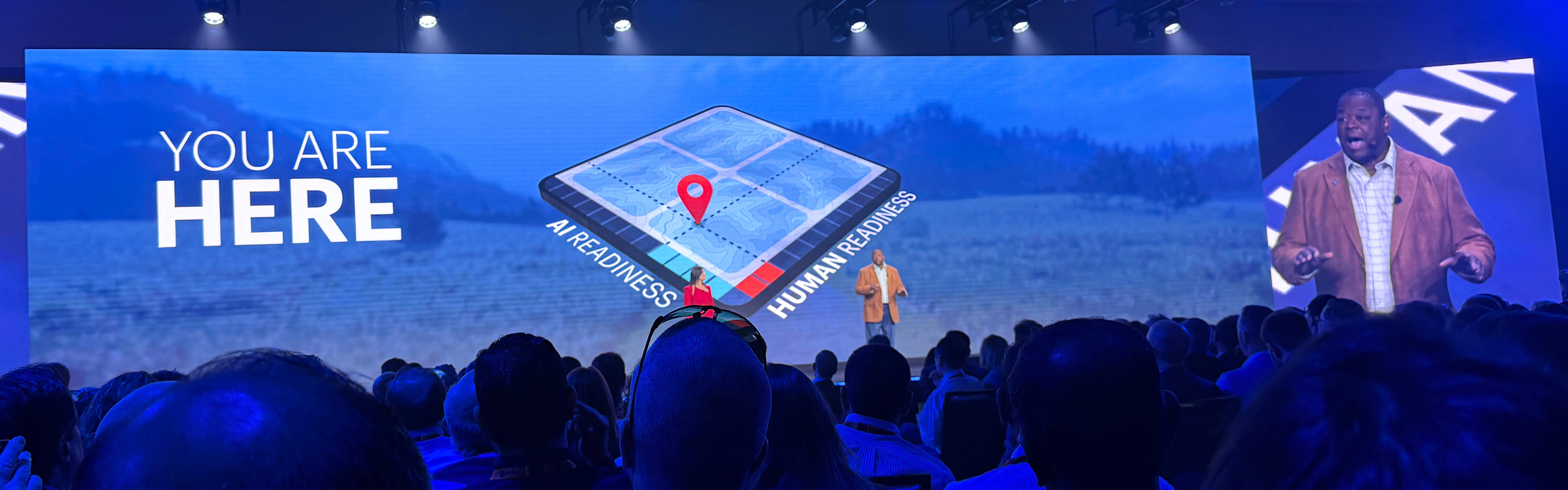
AI Is Creating a Historic Opportunity to Reinvent Work
The promise of AI is that it will handle administrative burdens, freeing up human talent for more creative, strategic work. The emerging reality reveals an important choice, how will we consciously direct the time AI gives us back?
Consider the opportunity.
Many professionals are using generative AI to handle routine communications and information synthesis. The time saved represents a once-in-a-generation chance to redesign our work around what truly matters: deep thinking, innovation, relationship building, and strategic initiatives.
But here's where it gets complicated.
What will we actually do with this reclaimed time? Will we embrace a healthier work-life balance, investing in creativity and restoration? Or will we simply compound our efficiencies, setting ever-higher expectations for deliverables in impossibly short timeframes?
The tension is real, and the answer likely lies somewhere in the middle. Organizations need to make intentional choices about how they redeploy the hours AI returns to them, choices that honor both business objectives and human sustainability.
This reframes AI implementation as an exciting design challenge. Success isn't just about deploying technology; it's about intentionally reshaping our workflows and habits to emphasize high-value human contributions. Organizations that couple AI adoption with thoughtful work redesign will unlock extraordinary productivity gains while making work more meaningful and engaging.
The Key to AI Success Is Inclusive Transformation
Leaders increasingly recognize that successful AI adoption requires bringing people along on the journey. The most forward-thinking organizations are discovering that employee engagement is the unlock for AI transformation.
Research suggests that by 2028, AI initiatives that fail will do so primarily because they didn't adequately address the human side of change. (Gartner Keynote, “Walking the Golden Path to Value”)
The solution is clear and achievable:
-
1. Involve employees in AI implementation
-
2. Build trust through transparency
-
3. Design technology that clearly augments, rather than replaces, human expertise and judgment
This highlights a fundamental opportunity to strengthen organizational culture through successful AI transformation. By actively engaging teams in automation decisions, demonstrating how AI enhances their capabilities, and celebrating the unique value of human creativity and insight, leaders can build more resilient, innovative, and engaged organizations.
In a World of AI, Human Authenticity Becomes More Valuable
As AI-generated content becomes widespread, enriching our digital platforms with text, images, and media, a powerful complementary trend is emerging, "Human-Made Premium."
In the future, the ability to verify authentic human creation will become a valued differentiator and mark of quality. As AI handles routine content creation, human creativity, judgment, and artistry will command premium positioning. Writers, artists, and creators will distinguish themselves by showcasing their uniquely human perspective and verifiable authenticity.
This shift will create new opportunities in content, media, and creative industries. Enabled by Digital Provenance systems that verify origin and authorship, we're entering an era where human and AI creation coexist, each valued for their distinct contributions. In a world enhanced by artificial intelligence, this provides the foundation for a new appreciation of human creativity and authentic connection.
The Real AI Revolution Amplifies Human Potential
The opportunities explored here share a common thread; the most significant impacts of the AI revolution are not purely technological, but organizational, cultural, and deeply human. Beyond the excitement about models and platforms lies the more inspiring challenge of empowering our workforces, reimagining our business models, and strengthening trust in a world where human and machine capabilities combine.
These are not distant possibilities; they are active opportunities emerging now. As we embrace powerful AI tools, the most important question we can ask is not just what the technology can do, but how we will harness these capabilities to unlock human potential and create more meaningful, productive, and fulfilling work.

 Initial Alert
Get in Touch
We'd love to see how we can make an impact for you. Let us know what you're working on.