
See how our services
make an impact.
You Asked, We Answered: Tonic & GadellNet — AI Edition
Our most fielded questions (and answers!) from Tonic and GadellNet's "Where AI Meets People, Governance, and Protection" event
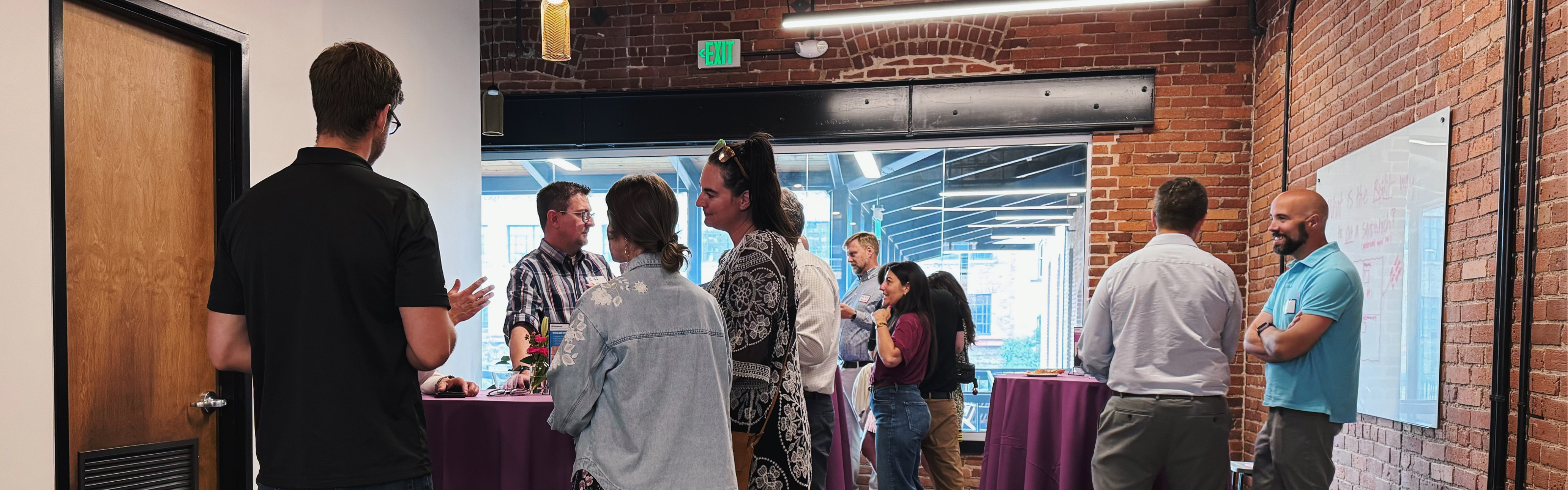
What happens when a community comes together in one room to talk honestly about AI, the best practices, the concerns, and the real perks of putting it to work in their business? Authentic conversation and genuine connection. Last week Tonic hosted "Where AI Meets People, Governance, and Protection," an event centered on networking and creating a welcoming environment for industry Q&A on all things AI. Co-hosted with our local partner and fellow B Corp, GadellNet, we couldn't be more grateful to everyone who joined us. The room was a mix of seasoned industry leaders and folks just taking their first steps with AI, and that range is what made the evening so special. The questions were sharp, the discussion was candid, and nobody had to pretend they had it all figured out.
Couldn't make it this time? We asked our Tonic subject matter experts to share the questions they fielded most throughout the night. Read on for Tonic's take on AI integration, governance, and protection, and a look at what we're hearing from our communities as they navigate this moment right alongside us.

Ellen Caviglia Clark
Chief Executive Officer
Q: What are AI agents, and how should we use them?
A: An agent is an AI that can perform tasks for you, autonomously.
Think of the difference between asking someone how to book a flight and asking them to book it. An agent is the second. It takes a goal, breaks it into steps, uses your systems, your email, your calendar, your inventory, and gets the work done, only checking in when it needs a decision.
This is genuinely useful. It's also riskier than a chatbot, because you're handing work to something that doesn't know what it doesn't know. Our advice as you get started: a person should approve anything that matters. For example, the agent can sort the inbox and draft every reply, but a human hits send. Treat the first few months like a new employee's onboarding period. After that, you'll know what it can and can't handle and feel more comfortable with it working autonomously.
Q: Where should we start with agents?
A: Look for workflows that are highly repeatable and low risk for the business.
Frequency helps pay back the setup effort. A task performed multiple times a week, or by a lot of people, usually returns the investment more quickly. The low-risk requirement protects the business while learning happens. Anything higher risk; touching money, compliance, or an unreviewed customer communication should wait until your team has a handle on the process.

Q: Who in the company should own AI strategy and planning?
A: At least one named person with real hours set aside and the authority to change how work gets done within the company.
The most common mistake we're seeing is AI treated like a technology project rather than an organizational one. Real value comes from AI actually changing how work gets done, and that takes an org-wide effort and willingness to change. In practice, the best owner is usually the person who can understand how work moves through your company, not the person who knows the most about AI.
Q: How far behind are we?
A: Probably less than the headlines suggest.
The adoption numbers disagree with each other by forty points depending on who's counting. Companies using AI consistently overestimate how many of their competitors are. In fact, one Salesforce survey found that 80% of small businesses already using AI assumed it was common among their peers, while only about a third of non-users agreed. So that "everyone's ahead of us" feeling is often more perception than reality.
That's why it's a great time to get started if you haven't. The real value of a head start isn't being first, it's experience. Early movers have a year or two of learning what works in their own business, and there's no shortcut to that.

Dusty Fields
Director, Engineering Innovation
Q: What is "Innovation"?
A: Innovation is applied change that creates measurable value.
Applied means it shipped, so ideas and concepts don't count. Change means it's a different path, not a faster version of the old one. And measurable value means someone can trace it to revenue, margin, speed, or risk, which is also how I'd expect my own function to be judged.
Q: How do I keep my team aligned on AI?
A: Alignment is usually an operating problem and not always a communications problem.
AI efforts stall out because everyone is working from a different definition of success and nobody can see what is in flight. Nearly every company is experimenting now, but only a small group can see value, and the ones who can got there by redesigning workflows rather than by picking better tools. Give your team shared language, and a visible pipeline of use cases with owners, then spend far more on enablement than you do on licenses.
Q: Where do I go to learn about AI?
A: Go to primary sources and those who are hands-on in the industry. Treat the commentary as entertainment.
Read the model providers' own documentation and work through their free courses, then anchor yourself to independent measurement like Stanford's AI Index when you need a neutral read on where the industry is. The newsletters, the conference keynotes, and the LinkedIn posts are all downstream of those two, usually several weeks late and several degrees more confident. Real learning starts the moment you point a model at a workflow you own.
Q: Why do I need to use AI?
A: You don't need to use AI, you need to stay competitive, and AI is currently the best lever on knowledge work throughput.
Inside its capability range it makes people meaningfully faster and their output measurably better. Outside that range it makes confident people wrong, which is a governance problem. The largest gains land on your least experienced people, which is why this is a team decision and not a personal productivity hack.

Where do we go from here?
If there was one thread running through every conversation last week, it's that AI adoption isn't really a technology problem, but an opportunity to reflect on your practices, your people, and the fundamental ways you and your business work. The questions above are proof. Whether you're scaling an established AI strategy or just figuring out where to start, most are asking the same thoughtful questions as the leaders in the room, and there's real value in not having to answer them alone.
A huge thank you to GadellNet for partnering with us, to our subject matter experts for showing up ready to dig in, and to every attendee who brought their curiosity and questions. This is the kind of conversation we love to be part of, and it won't be the last, so keep an eye out for similar events coming down the road!
If any of these questions hit close to home, or sparked a few new ones, reach out through our contact page or via the footer below. We'd genuinely love to keep the dialogue going.


 Initial Alert
Get in Touch
We'd love to see how we can make an impact for you. Let us know what you're working on.