
See how our services
make an impact.
From Browsing to Booking: Modernizing Trip Discovery for Nat Hab
How Tonic helped Natural Habitat Adventures turn a sprawling trip catalog into a search experience guests can actually use, and marketing can actually own.
Picture a traveler who knows exactly what they want. Polar bears, sometime in October, maybe with a camera in hand. The trip exists. Finding it shouldn’t be the hard part of planning.
For Natural Habitat Adventures (Nat Hab), it was. Their catalog spans polar bear departures in Churchill, Galápagos voyages, African safaris, and photo expeditions across 12 world regions. The site offered only a thin keyword box and static regional lists. Guests could see the trips; they just couldn’t find the right one.
Meanwhile, travelers were getting used to something better. Competitors were already letting guests narrow trips by interest, destination, and date. Nat Hab wanted that experience for their guests, and they wanted their marketing team to own it without a developer in the loop.
Enter Tonic. We built a global trip search and regional filtering system on a new structured content foundation. Nine months after launch, the search is fielding roughly 26,000 searches a month, and marketing runs it themselves.
Here’s how we got there.
The Challenge: The Trips Were There. The Path Wasn’t.
On the surface, the fix looked simple: give guests a better search. But a search experience is only as good as the information underneath it, and once we looked closely, the real problems ran deeper than the search box.
The trip data itself wasn’t built to be searched. Details like region, country, interest, and wildlife were stored as loose strings of text on each trip, so the site had no reliable way to know that a trip meant “Botswana” or “photography.” Nothing could be filtered, because nothing was truly organized.
Departure dates were trickier still. Months, years, and trip lengths lived in Nat Hab’s reservation system, not in the content system that powers the website. They also change constantly as trips sell out and new departures open. Hand-maintaining those details on the website was never going to be sustainable.
The rest of the experience had gaps of its own:
- Regional pages were static lists, with no way to narrow by interest, month, or year.
- Marketing had no control over search. They couldn’t decide what appeared, or in what order, without pulling in engineering.
And the work came with real constraints:
- No rebuild. The site runs on Astro, so any new interactive search had to fit inside the existing site.
- No downtime. The timeline was aggressive, and the current catalog had to keep working the whole way through. Breaking changes weren't an option.
In other words, build something new without breaking anything that already worked.
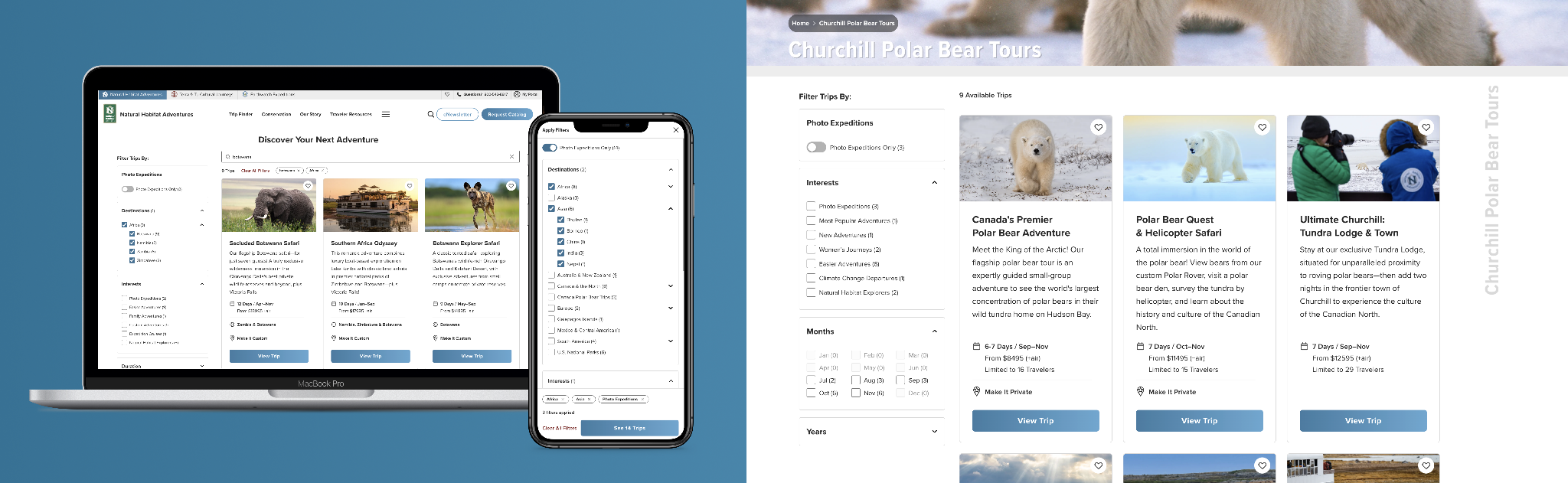
The Work: Letting the Trips Take the Spotlight
Our goal was never to make the technology the story. Nat Hab already has the brand, the trips, and the conservation mission. What they needed was for design and engineering to get out of the way of all three, so a guest arriving on the site meets the adventure, not the interface.
Guest experience doesn’t start at the airport. It starts at the first click on the website.
With that in mind, we designed and built two solutions: a global trip search engine powered by Algolia, and a filtering system across every region page. Both sit on a modernized content model in Contentful, the system Nat Hab uses to manage their site content.
Starting With the Data, Not the Search Bar
Rather than bolt search onto messy legacy fields, we started underneath it. Region, sub-region, country, interest, and wildlife each got their own organized home, so every trip could be tagged in a consistent, searchable way. We added structured departure details (months, years, duration, and price) along with trip flags like photo expeditions, women’s departures, and extensions.
How we made the change mattered just as much. Every update was additive and proven in a separate test environment first, so the live site’s content stayed intact the whole way through.
Letting the Reservation System Do the Remembering
Dates were the part that couldn’t be left to people.
Departure availability is the most volatile data in adventure travel, and the most costly to get wrong on a search result. So we connected directly to Nat Hab’s reservation system and fed months, years, and duration into the new content model automatically.
Now a guest filtering for Botswana in October sees what’s actually bookable. And no one on the content team has to remember to update a trip when its schedule shifts.
Search That Works the Way Guests (and Sales) Do
That content model became the single source of truth for search. Guests can filter by interest, wildlife, region, country, month, year, and duration, with typo-tolerant keyword search working right alongside. Behind the scenes, Nat Hab’s team controls how results are ranked with a simple spreadsheet upload. And because we built it inside their existing Astro site, they got a modern, interactive experience without a rebuild.
We also made sure every filtered view stays shareable. A link like “nathab.com/africa?countries=Botswana” drops a guest straight onto Botswana departures in the Africa region. That’s how Nat Hab’s sales and marketing teams point prospects, newsletter readers, and campaign traffic at a specific slice of the catalog. The new search kept that workflow intact.
Built as One Conversation, Not a Handoff
We designed it with Nat Hab, not for them. That meant prototypes, hands-on sessions with their leadership to shape the filter logic, client testing before launch, and a staged rollout. Filter logic and the data model were shaped in the same room, because the categories a guest sees are a design decision and a content decision at the same time.
And launch wasn’t the finish line. Once guests got their hands on the new search, we watched closely, and what the data told us shaped what came next.
The Outcome: A Website That Works Like a Good Guide
The new search launched seamlessly. But the real measure of success is what’s happened since.
Guests find their trip in a few clicks
One global search now covers the full catalog, replacing a keyword box that couldn’t answer real trip questions. Someone who cares about polar bears, or photography, or traveling in October can find a matching trip in a few clicks, and meet the conservation story behind it along the way.
Marketing owns the experience
Nat Hab’s marketing team now decides what appears in search, how it’s ranked, and which filters guests see, with no developer in the loop. Departure dates stay accurate on their own. And shareable filtered links keep powering eNews and campaign traffic, just as the sales and marketing teams need.
Guests keep coming back to it
Nine months after launch, the search handles about 26,000 searches a month, or roughly 850 a day, with no month-over-month drop-off. That’s not a launch spike, that’s a habit.
The data is steering what’s next
Analytics showed that 64% of searches were filter-driven, compared with 36% by keyword. Guests were telling us how they like to explore by what they care about, not by typing guesses into a box. That finding redirected effort away from a redundant search bar and toward the filters guests actually use, now shaping design and navigation decisions across the site.
Built to grow
New trips and new categories slot into the existing structure instead of requiring rework. As Nat Hab’s catalog grows, search grows with it.
Where the Journey Starts
Somewhere right now, a hopeful traveler is filtering for polar bears in October. They’ll never see the data model or the reservation integration behind their results, and they shouldn’t have to. They’ll just find their trip.
For Nat Hab, that foundation was only the beginning. What started as a search project has grown into an ongoing partnership, and we’re excited for what comes next.
Is your website standing between your customers and what they came for? Let’s talk.

 Initial Alert
Get in Touch
We'd love to see how we can make an impact for you. Let us know what you're working on.